From Private Room to Public Image: The Casino Interior
See how the casino interior shifted from guarded room to public spectacle, and learn to read what its doors, sightlines and displays communicate.
A casino interior tells you who is welcome before anyone says a word. The casino interior began as a room of controlled access, but its cultural image now depends on being seen: bright thresholds, open sightlines and a sense of activity spilling into view. That change was not simply a move from dark to bright. It reflects shifting ideas about privacy, status and spectacle.
To read the room, look at the boundary first, then ask what the layout reveals and whom it invites to look. This is useful whether you are studying a historic image, designing a fictional setting or trying to understand why the familiar casino scene feels so theatrical.
Why does the entrance feel like a test?
A guarded entrance can make a room feel private even when the space beyond is large. In older social settings, access itself carried meaning: a threshold, a doorman or a separate entrance could distinguish insiders from passers-by. The visitor was not merely entering a room; they were being admitted to a particular kind of company.
That distinction is easy to lose when looking at a photograph. A closed door may suggest exclusivity, but it can also signal ordinary concerns such as keeping noise in or controlling the flow of people. Look for several clues together: who stands at the threshold, whether the doorway is visible from the street, and whether the interior offers itself to view.
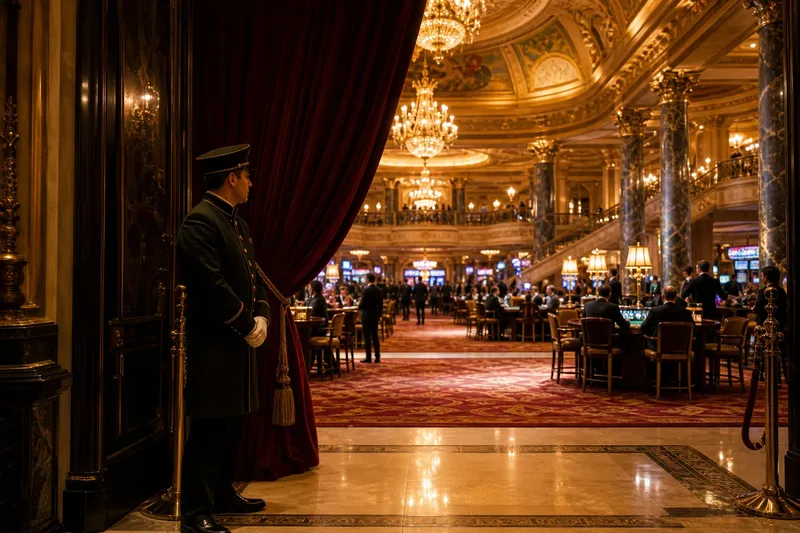
Imagine a fictional casino depicted in a painting, with a narrow entrance and a curtain just inside. If the figures outside cannot see the tables and a uniformed attendant controls passage, the image suggests that privacy is part of the room’s identity. The expected reading is not simply “dark and old-fashioned”; it is that access is being staged as a privilege.
What usually makes a room feel too private?
When a casino setting reads as secretive rather than socially selective, the cause is often an accumulation of boundaries. Heavy doors, screened windows, small pools of light and a lack of visible activity can leave the viewer with no sense of how the room connects to the world outside. The result may be atmosphere, but it can also make the scene feel sealed off.
Try tracing the route from street to central space. Is there a transition area, such as a lobby or corridor, or does the scene jump from public pavement straight into an enclosed room? A visible sequence helps explain how a visitor crosses from one social setting into another. If the image gives no such clue, add a threshold detail rather than making every surface brighter.
In a fictional illustration, a designer might find that a curtained entrance and dark walls make the room seem inaccessible. Adding a lit vestibule and a glimpse of movement beyond the curtain would preserve a sense of privacy while showing that the room belongs to a larger social world. The expected result is a boundary that feels managed, not absolute.
How did display become part of the room?
As public entertainment became more closely associated with spectacle, the casino interior had to communicate its character to people who might never enter. Lighting, ornamental ceilings, visible activity and carefully composed views could turn a room into an image as well as a place. The point was not merely to decorate; it was to make the setting legible from a distance.
Display changes the relationship between those inside and those outside. A private room directs attention inward, towards its members and rituals. A room designed for public image also anticipates an audience: a visitor at the entrance, someone looking across a lobby, or a viewer encountering a photograph later.
This does not mean every exposed surface is spectacle. A grand staircase can direct attention towards an arrival, while a broad opening can make activity visible without showing every corner. Ask what the composition wants you to notice. If the brightest feature is the entrance, arrival may be the drama; if it is the room’s centre, the gathering itself may be the show.
Why can an open layout still feel closed?
Openness is not the same as welcome. A large room may offer long sightlines yet still feel difficult to approach if its central area is visually dominant and its edges provide no comfortable place to pause. Conversely, a smaller room can feel accessible when it offers clear routes and a visible point of orientation.
When an open plan feels imposing, look for a mismatch between what the room reveals and what it asks a visitor to do. A viewer may see everything but have no obvious route through it. Repeated columns, changes in ceiling height or a shift in floor material can help divide space without restoring the old sense of secrecy.
For a fictional scene, imagine a broad hall where the entrance opens directly onto a central gathering. If the scene feels more like a stage than a place to enter, a side passage or a quieter edge zone could provide a second route and soften the first impression. The expected effect is a room that remains visible while offering more than one way to inhabit it.
What does a casino interior communicate about its audience?
A room communicates through the choices it makes visible. A single controlled entrance suggests that admission matters. Multiple approaches and clear views can suggest a broader public, while a prominent balcony or overlook can turn observation into part of the experience. These details shape a room’s social character without needing a sign to explain it.
There is a common interpretive snag here: treating a lavish interior as proof that everyone was equally welcome. Spectacle can invite attention while still organising people into distinct roles—those who enter, those who watch and those who manage the space. To avoid that simplification, notice where a viewer can stand and what each vantage point permits them to see.
Read the room as a set of relationships. Who is visible to whom? Which routes cross, and which remain separate? The answers can reveal more about privacy and status than ornament alone.
How do thresholds, sightlines and lighting shape the reading?
What does a threshold tell you?
A threshold shows where one social setting ends and another begins. Compare the street-facing entrance with the first interior space, and note whether the transition is abrupt, ceremonial or easy to overlook.
How can you read a sightline?
Follow the direction in which the room seems to guide the eye. A view that leads towards a central gathering makes activity the focus, while a view that stops at a screen or doorway gives privacy greater weight.
What does lighting reveal?
Notice what is illuminated and what remains in shadow, rather than treating brightness as a simple sign of openness. Light can draw attention to an entrance, a gathering or an architectural feature while leaving other areas deliberately unreadable.
How can you tell whether the room is staged for an audience?
Look for a viewpoint that seems carefully composed: a balcony, a long approach or an opening that frames the interior. If the room makes sense from the position of an observer as well as a visitor, public image is part of its design.
What should you try when an interior feels like a cliché?
The familiar casino image often leans on a few loud signals: darkness, glitter and a crowd. These can establish a mood quickly, but alone they say little about how privacy, display and spectacle work together. A more convincing reading begins with the room’s social logic.
- Start at the boundary. Identify the entrance, any screening and the point where a visitor can first see inside.
- Map the view. Follow the main sightline and note what it makes prominent or hides.
- Separate looking from entering. Ask whether the room has places for observers as well as participants.
- Check the edges. Look for quieter routes or places to pause that balance the central display.
- Read ornament in context. Ask whether a feature directs movement, marks status or simply catches the eye.
These checks are more useful than adding another decorative flourish. They help explain how a casino room became a recognisable public image: not through a single style, but through the careful negotiation between invitation and control.
When you next see a casino interior in an illustration or film, look first at who can see the room from the doorway. That small decision often reveals whether the setting is presenting itself as a guarded private world or as a spectacle made for public attention.